Tuesday, July 1, 2014

Holy Cow!


The whole controversy regarding Sai Baba was quite unnecessary to say the least. Dwarka Shankaracharya need not have expressed his opinion, even if he felt very strongly about it. Hindu or Muslim, Sai Baba is the object of affection, adoration and devotion for millions who consider themselves Hindu and do not seem to bother about the religious convictions of Sai Baba. Hindu Seers supporting the Shankaracharya's views have sought to highlight scriptures and various 'acts' of Sai Baba which seem to indicate that he was not a God. Needless to say, it has not helped further their cause. What is even worse probably is the fact that millions of adherent Hindus who believe wholeheartedly in the Sanatan Dharma, seem totally unconcerned with the whole controversy. Imagine, The utterances of a Holy Seer going unheeded this way!

But then that is how the Hindu religion is! Diffused, Omnipresent and yet not rigid but rather fluid. Unlike Abrahamic religions which have clearly stated dos and donts and scriptures that in many cases form the law, Eastern religions have tended to be more ethereal. Dharmic religions belonging to Indospehere and Chinese/Japanese/Korean religions belonging to Sinosphere tend to deal with 'may/may nots' rather than Western religions that are more of 'can/can not'. The result has been an explosion of conflicting opinions, diverse cultural mores and habits that indicate a total lack of cohesion, but scratch the surface and you shall find layers and layers of similarity and commonness. Contrast this with western religions, where homogeneity is the norm.

When West met East, notably during the colonial era, West imposed its understanding of culture and society on the East. Manusmriti was understood by British colonizers as the Hindu equivalent of the Quran or the Talmud, which it certainly was not. Practices that the westerners found abhorrent, were termed as superstition (which in our understanding today, surely were superstitious). As Hindus became more prosperous and materialistic over a period of time, faith in Godmen and Seers and Saints dropped in this most religious corner of the world,  Add to this the inherent fluidity of the religion to accept all views (even if they be diametrically opposite) has resulted in Hinduism being a religion practiced at home and thus varying from home to home. Barring a few recommended visits to famous temples and prayers at holy rivers, Hinduism is actually a way of life, and not so much a religion in the western sense.

India's independence and the Nehruvian belief in majority communalism being more dangerous further dented whatever consolidation could have happened amongst the right-wing Hindus that could have resulted in a rigidification/restructuring of the religion. Other than the failed Cow slaughter ban movement and the partially successful Ram Janmabhoomi Andolan, Hindus have remained a diffused and distributed lot. Combined with the inherent tolerance and respect for other cultures has meant that Hindus would be as likely to pray at a Pir Dargah as at Kashi Vishwanath temple. Given this political and social background, the Shankaracharya's rejection of Sai Baba goes against the grain of the religion which he claims to lead. 

Which is a sentiment best summarized Rig Veda which says

'एकम् सत् विप्राः बहुधा वदन्ति'- Truth is One, though the Sages know it by many names!

Friday, March 14, 2014

Cry-me-a Ukraine


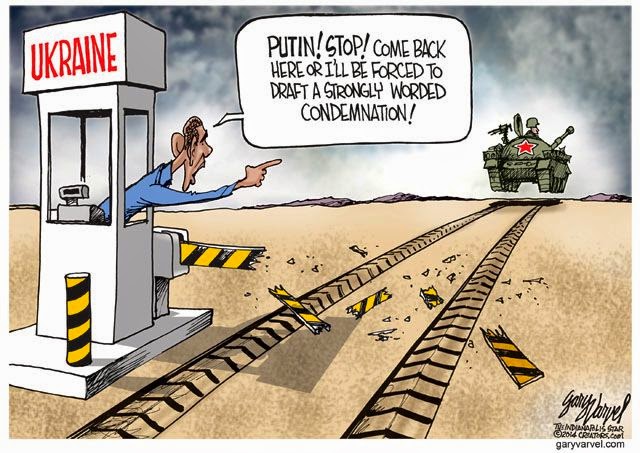
In a way that combines the best practices of the Soviet era- stealth, deception and intrigue with the best practices of its Russian successor state- brawn, brain and courage, Putin has succeeded in catching the West unawares. While the Americans, the Germans, the French and the British were toasting champagne for having wrested another East European country out of Russia's sphere, Putin was silently working behind the scenes to create a situation which is now being called the return of the cold war.

Kiev exploded into protests once President Yanukovich at the last moment backed out of accords that would have brought Ukraine a step closer to the EU, choosing instead the massive waivers that Russia was strategically offering. Kiev protests were nothing new- protests are now a standard feature of almost all modern nation states- Kiev was hosting protests in Maidan square, just as Dhaka had witnessed its own in Shahbag square, Cairo in Tahrir Square, Bahrain in Pearl Square and so on and so forth. This is now a routine internal matter of any nation. However, Ukraine was to be the prized possession of the West, another humiliating blow to post Soviet Russia. And hence the West intervened- High profile visits by diplomats and statements by Presidents and Prime Ministers. Western portrayal of events in Kiev showed that a revolution was brewing against the unpopular rule of Yanukovich who deserved what he was getting.

Well, Yanukovich wasn't exactly the most popular President that Ukraine had ever had. He had been ousted from power once earlier during the Orange Revolution. But he had inched back to power primarily because the forces that had led the Orange Revolution had dissipated their energies in fighting each other and because he had a genuine following in the Russian speaking majority in the Eastern part of Ukraine. But now in sort of a deja vu, people were clamoring for his ouster once again. After days of blowing hot and blowing cold, offering sops and asking police to intervene, Yanukovich realized that his days were numbered. He simply fled.

The transitional government that took power in Kiev immediately turned to EU for support and membership. In an befuddling move, it also rescinded a 2012 law that made Ukrainian and Russian the official languages of the state. Now, it was time for the Russian majority and industrialized East to explode. As Putin watched, undoubtedly with a smile on his face, Russian speaking Ukraine disowned the new national government in Kiev. In Crimea, pro Russian troops took control of the autonomous territory that Khrushchev, for reasons best known to him, had transferred from Russia to Ukraine. Putin, subtly aided the process. Tourist protestors crossed in from Russia to Eastern Ukraine to protest against the fascist dispensation in Kiev that was hell bent on obliterating Russian speakers in Ukraine. From Donetsk to Luhansk, From Kharkiv to Sevastopol, protestors took over Government buildings and unfurled the Russian tricolor.

Crimean Parliament in the meanwhile called for a referendum to reunite Crimea with Mother Russia. Suddenly, the West woke up. Realizing that the tables had completely turned against them, Obama, Merkel and the Who's who of the West frantically engaged with Putin and his administration, coaxing, cajoling and threatening him to respect Ukraine's territorial integrity. Putin on his part merely reiterated his stated position to come to the aid of Russian speakers anywhere in the world.


So that is where things stand as of now. It looks probable that Crimea will vote for integration into Russia. It seems probable that Kerry and Obama will go berserk. It seems probable that sanctions and counter sanctions will be liberally applied. But one thing is certain, Russia has risen again!! 

Tuesday, February 4, 2014

(P)AAP


Lord Kejriwal has spoken once more. Perched on a platform, towering over his worshipers, he has named the corrupt-the scum of Indian politics. They must be hounded and made to suffer. After all, none other than the almighty Lord himself has so ordained. At least that is what Kejriwal and his AAPists would have us believe. Kejriwal is the incarnation of Buddha, Krishna, Jesus and Zoroaster, raised to the power n. He is the embodiment of truth and courage in this Kalyug. He was sent down by the God himself to rid India of all her ills. He is the modern day messiah, who comes to spread his religion of honesty, probity and accountability, not with a sword, not with a Gospel but with Dharnas, Anshans and Pradarshans. God almighty has sent him to us to make India once more the land of bounteous milk and honey, the eternal golden sparrow.

This cult of personality is frankly very sickening. Kejriwal's and AAPists' self portrayal as posterboys of India's vibrant democratic structure is unnerving at the very least. Their lofty ideals and their claims of being different and better than all others in the political fray is disgusting. The fact of the matter is that AAP is like any other political party in the country, composed of power hungry and ideology-less goons who want to be known as leaders. There is one difference though, while other established national political parties are slowly moving away from evil of populism and disruptive democracy, Kejriwal and his party seem to be espousing the ideals of 'mob democracy' to force the Kaffirs to believe them and their ideas.

Let us look at AAP's record till date. For AAPists, Intra-party democracy is not very different from a Khap panchayat. Party elders sit and decide what is right and what is wrong and the rest of the party must toe that line. Speak up and you are branded a heretic, Speak louder and you will be purged ( remember Binny?). Classic replication of Lenin and his "Democratic Centralism", Stalin and his "Purge Trials",isn't it?

Now, Let us look at law and order. See now, that is a wrong question. Central Government is responsible for law and order. What can Kejriboy do? He can scream, shout and protest, which he is doing anyway. Poor, Old, Sheila Dixit, hounded as she was by these AAPists for crimes against women. She lost the election on an issue that wasn't even hers. But then, she did not sit on a Dharna- see now thats the difference.

What about power? First nothing and then up, up and away and why? Lo and behold- Private power companies are corrupt, they are holding the government to ransom, they are the bad guys. Lets throw them out!  

I can keep rambling but honestly, I have lost interest in this politics of blaming, in this politics of 'I am holier than thou',and worst of all, in this politics of 'if you disagree with me, you must be evil'. In an earlier post I had expressed fears that Kejriboy would be India's Robespierre. I am afraid that it seems that I was right.AAP to me symbolizes a gross misrepresentation of Young India's aspirations. Where India wanted stability, AAP offers anarchy, Where India wanted progress, AAP stands for hindrance, Where India wanted democracy, AAP believes in a cult of personality. Devoid of any coherent ideology, AAP, to me, is no different from any other regressive political party with a provincial mindset and parochial attitude. 

So much for being the next big thing on India's political scene.

Monday, August 5, 2013

Federal woes

Successive national elections have seen the power of a strong central government wither away such that the idea of a strong, one-party central government seems inconceivable today. The decline in the fortune of national parties has been to the gain of regional satraps who, today, rule over many states as their fiefdoms. Mulayam and family in UP, Karunanidhi and clan in Tamil Nadu, the Abdullahs in J&K, the Chautalas of Haryana and the Gowda father-son duo of Karnataka- other than the Hindi heartland states of Rajasthan and Madhya Pradesh, hardly any state in India can today boast of a strong presence of the national parties- Congress, BJP and the communists to a certain extent.

The rise of regional parties was inevitable, given the sheer diversity of the populace that inhabits the country, and probably it is good in a way, since it keeps dictatorial tendencies à la Emergency in check. But, the lack of strong political consensus in the country, in the form of electorate voting decisively for one or the other party or combination has now begun to take its toll on the strength of the central government. A strong central government is what the makers of the constitution had in mind when they drafted the Indian constitution. Accordingly, India practices a faux-federalism in which most of the power resides with the centre, even though there is a  strong semblance of devolution of powers to states. With national parties losing their popularity, all elections since 1996 have seen governments of the largest national party being propped up by regional parties. Things have come to such a pass now, that central government is unable to enforce its writ lest it chooses to anger its regional allies, and ends up losing power at the centre as well. Take the case of Durga Nagpal for instance. The moment Sonia Gandhi spoke in support of the suspended IAS officer, Samajwadi Party announced its opposition to the crucial Food Security Bill. Things came to such a pass that one of the SP leaders asked the Centre to withdraw all its IAS officers if it was so worried. All this, even when the whole world knows that Durga Nagpal is being victimized for taking on the strong sand mafia. 


India has been weakest when the Centre has been weak. The invasions of Mahmud of Ghazni, Abdali,  Nader Shah and the British, took place when India was at best a patchwork of territories, lacking a strong leadership. If the predictions for the next elections are correct, India will again end up without a strong, credible central government, something that does not bode well for the country. India-the superpower of 21st century, most definitely needs an able and an effective central government.

Wednesday, July 31, 2013

Language woes


In 1947, religion was identified as the most fundamental unit of nationalism in the sub continent. Proponents of this theory claimed that since Hindus and Muslims belonged to separate religions, they belonged to different nations. Accordingly, India was partitioned into a Hindu majority India, flanked on the east and west by Muslim majority Pakistan. In 1971, Muslim majority East Pakistan claimed that it was not religion, but language that was the most fundamental social identifier in the sub continent. Accordingly, Bangladesh was born. Agreeing with the same logic, Lankan Tamils fought decades of bloody and destructive battles with Lankan Sinhalese.

 In India too, in spite of the initial aversion of national leaders such as Nehru and Patel, language was identified as the primary differentiator between Indians and the State reorganization bill of 1956 gave a formal go-ahead for states based on linguistic homogeneity. This principle of language based states has served India well so far-Punjabi (sikh) nationalism was tackled by creation of Punjabi suba, Marathi nationalism by creation of Maharashtra, Gujarati nationalism by creation of Gujarat and so on and so forth. Proponents of this linguistic theory of self-identification feel that Balkanization of India was prevented largely by acceptance of regional aspirations in the form of creation of states based on linguistic homogeneity. Even in the sub continent for that matter, reinstatement of Sindh as a province tackled the demand for Sindhudesh and creation of autonomous Tamil zone silenced in guns in Lanka for some time. 

India, however has chosen to sacrifice that principle as a government counting its days attempts to pander to vote bank politics. The decision of the UPA government to create a second Telugu state in the form of Telangana, in spite of strong opposition within Andhra is nothing but a despicable attempt at holding on to power in the next elections. The demand for Telangana is not new, it has persisted for several decades now. The demand for a separate state for the Telugu speaking, former Nizam's territories stems not from some regional aspirations but from a perceived discrimination in a united Andhra. Instead of seeking to safeguard rights of the people and addressing their grievances, the Central government has chosen to give assent to Telangana. Strong objections such as similar demands from other regions in the country, threat of naxalism, sharing of resources were all overlooked for the short term aim of electoral politics. Such is the state of affairs in the land of Gandhi today!

Such political short sightedness is not new to the Congress. After all, the Congress did create Bhindranwale to counter the growing clout of the Akalis in Punjab. Everyone now knows what a disaster that turned out to be for the country. By creating Telangana, Congress government has sent out a clear message- Agitate and get what you want. The cycle of violence will now resume in Bodoland and Gorkhaland. Petty politicians will form parties demanding Vidarbha, Saurashtra, Tulu Nadu, Kongu Nadu, Bundelkhand, Harit Pradesh, Mahakoshal and what not. Probably, one day in the future, surely under a Congress government, every residential colony will be designated as a state!


The solution to lopsided development is not creation of smaller states. Jharkhand is a sad example of what all can go wrong even in smaller states. The solution to meeting people's aspirations is commitment to common good, probity in public life and ethics- all of which our politicians lack today! Creation of Telangana, while surely meeting the aspirations of a few, will go down as one of the most disastrous decisions taken by the Congress government, now clearly, in its death throes.

Saturday, July 27, 2013

Lal Salaam!


Leftist ideologues waste no time in raving and ranting about the grave injustices perpetrated by the state in undeveloped tribal homelands that drive people to take up arms to challenge the might of the state and assert their rights on what is rightfully theirs. Right wingers view the maoist problem as a menace to national security and demand that the state impose itself in totality to establish control over brigand infested lawless areas. Caught in the battle of ideologies are the dispossessed tribals, security men and occasionally a convoy of politicians. The result is a blood bath, heightened media attention, flurry of activities by state agencies before the usual stupor sets in. Nothing changes and this cycle gets repeated endlessly.

Naxalism evokes strong reactions. Dispossessed and forgotten people raising their voices and railing against the state and its institutions is fine by me, but terror is where line gets drawn. If citizens (even though they perceive themselves as denizens) take up arms against the state, the state is fully justified in deploying all the resources available with it to convince these people to set their arms aside. Negotiations and developmental work is a part of the solution but breaking the morale of terrorists is another critical part. 

Maoism, socialist revolution, guerrilla warfare are all strategies of yore. They thrived in the post-colonial era where they represented a kind of 'breaking free of the past' ritual. Modern democratic societies allow innumerable ways of expressing dissent, one way is to debate things out in the assembly, another is to fast a la Irom Sharmila, another is to protest a la Kejriwal & co. Democracy always delivers, it may not deliver on time, but it always delivers!  Violence of the kind witnessed in Darbha Valley last month only serves to taint genuine causes with the tag of terror. Who talks about the plight of the landless tribals when the news item is that of a burning, smoldering vehicle carrying CRPF personnel, or the bloodied remains of Mahendra Karma or a grievously injured VC Shukla?


Maoists pride themselves on following Mao's teachings. But what did Mao leave behind? Misery and impoverishment of billions of Chinese. Che Guevara's legendary guerrilla tactics did not change the lives of ordinary Latin American peasants. Stalin murdered millions in the name of ideology, but where does his empire lie today? Extreme left wing ideology is a failed ideology, there is no instance in the world wherein it has delivered the utopia it promised. The State must help these wayward revolutionaries realize the follies of their ways, persuade them and if all fails, impose its power to establish order- The likes of Darbha are too stinging a slap on the face of the state and its institutions, the guilty must be brought to account. Order and peace must prevail at all costs.

Monday, June 10, 2013

Namonia


In 1966, the Syndicate had put Indira Gandhi on the throne, assuming she would be easy to control from behind the scenes. Within 3 years, Lohia's Gungi Gudiya had staged a coup of sorts by splitting the Grand Old party and claiming it for herself, effectively, ending the might of the Syndicate that had sought to rule behind the scenes. They say Modi is quite like Mrs. Gandhi in terms of determination and courage. They also say that he has her dictatorial instincts. Does it mean that history will repeat itself?

Advani seems to be facilitating just that. He brought back Modi from certain political annihilation in the 2002 Goa BJP national executive. 11 years later, he feels he has created a Frankenstein. His sudden and uncalled for resignation has thrown the party into chaos. Senior leaders are begging Advani to stay back. But the 'Lauh Purush' of yore is now a senile old man. He cannot read, or rather does not want to read the writing on the wall. The country wants change, and for once, it wants to do away old, aging leaders who have failed to move on with time. Advani needs to realize that he no longer has a constituency of his own, his rath days are now a part of a generation gone by. His exit may trigger an exodus of BJP leaders in the short run, but in the long run, it will encourage the likes of Modi to further entrench themselves into the organization and make themselves indispensable to the party. Already, there are reports of Modi-fied supporters asking Advani to be extended all courtesy but no compromise.

Modi has arrived on the centre-stage of Indian politics. You may love him or hate him, but he is the most popular leader in the country. Advani may pitch for Shivraj Singh Chouhan or even Raman Singh, but good as these leaders are as administrators, they do not enjoy even an ounce of popularity when compared to Modi. He has proven his capability repeatedly in winning Gujarat for the BJP and changing Gujarat's face through progress and development. He deserves to be rewarded. The voice of lakhs of BJP supporters must be respected and must overrule the antics of a petulant old man, who is driven solely by his lust for power.


India needs Modi solely because he has a proven track record of delivering on his promises. He has proven himself to be an able administrator and a strong decision maker. Detractors may choose to rave and rant about Godhra, but then sadly, that is the reality of Indian politics. Rajiv Gandhi stayed on as Prime Minister even when Sikhs were being butchered in the national capital! The country desperately needs to be freed from the UPA brand of politics and the BJP must present itself as a credible alternative under a capable leader- and NaMo most certainly is that leader!

Thursday, May 23, 2013

The A-war


In 1979, as Soviet Tanks rolled into Afghanistan, the might of the Capitalist West united under the leadership of US to turn Afghanistan into the Soviet Union's Vietnam. With every passing year, the US and its allies, notably Saudi Arabia pumped in money to create the Frankenstein's monster they called Mujaheddin. With every Soviet helicopter downed and Soviet soldier killed, the Mujaheddin gained prestige and power. The Soviets pumped money and resources, but they were no match for the Afghans, indoctrinated against the godless Communists in Pakistani refugee camps. Then, Gorbachev came to power and winds of change started blowing across the Soviet Union. Afghanistan suddenly became a black hole from which the Soviets desperately wanted to extricate themselves. The Geneva accords were hastily concluded and the last Soviet soldier walked out of Afganistan in 1989, bringing the war to an abrupt end. 

The war came to an end, but the suffering continued. Afghanistan found itself with millions of armed zealots who wanted to preach the word of Allah at gunpoint. Within Afghanistan, they fought government and each other, but they felt stifled, as if their wings had been cut. In the meanwhile, the Soviet behemoth collapsed and the façade of unity that had bound the so-called 'Unbreakable Union of the free republics' fell apart. The Armenians and Azerbaijanis were at each other's throats and the Muslim Caucasus was on fire. At about the same time, Yugoslavia imploded with Serbs, Croats and Bosnians ravaging each other. The Mujaheddin suddenly found themselves a job. Much like the Iranian revolution had spread political Islam in the Middle East, the Mujaheddin sought to promote their brand of Salafi, Saudi-style Islam to the newly liberated Muslim territories of the past. Bands of Mujaheddins swooped into Bosnia, Chechnya, Dagestan, Uzbekistan and even far away Somalia to create a Grand Islamic Emirate, a la Caliphate of the Islamic Golden period. Backed by their financiers in Saudi Arabia and their mentors in Pakistan, the Mujaheddins proliferated their ideas to unemployed and disenchanted Muslim youth in Europe, Asia and Africa, creating terrorists who ultimately struck at the heart of America on 9/11. From Kashmir to Kent, radicalized youth made terrorism a very live and real threat.

The US invaded Afghanistan to avenge for the 9/11 attacks within 12 years of Soviet withdrawal. The tables had now turned. Friends had become implacable foes. For more than a decade now, US and its NATO allies have propped up the Karzai regime, much like the Soviet backed regimes of Karmal and Najibullah. Obama now says that the Afghans must take control of their destiny. He wants the allies out of Afghanistan by next year, leaving behind a weak, venal and inefficient administration that will probably collapse within months of US withdrawal, if the Taliban choose to attack. With Afghanistan once again in the hands of the Taliban, history will repeat itself. An entire swathe of territory from South Asia to Europe will be destabilized. More blood will be spilled in the streets of Grozny, Srinagar, Mogadishu, even London and Paris and probably even Islamabad and Riyadh.

The Americans must not repeat the mistake made by Soviets a quarter of century ago. Afghanistan must be stabilized as a modern, prosperous and strong nation capable of looking after its own interests and handling its treacherous southern neighbor. A failed Afghanistan, once again, will be too costly a proposition for the world. 

Tuesday, May 7, 2013

Whither Marx?


Yesterday would have been Marx's 130th birthday. For a man whose ideas drastically changed the world as we know it, the occasion was a muted affair. Ever since popular movements toppled the so-called Marxist regimes in the late 80s and early 90s, Marxism has become a much maligned term. For neo-liberals, Marxism is the philosophy that gave rise to totalitarian dictatorships that butchered the voices of free people and tried to stamp out their conscience. Marxism, for them, is the evil that spawned murderous movements such as Stalinism and Maoism that claimed millions of lives in the name of building an equal society. For left-leaning intellectuals, Marxism is nothing less than the word of God. It showed that poor could take power and break out of the shackles of poverty and superstition that they had been confined to by the rich and the men of God.

Marx's theory was simple yet inspiring. He talked about giving power to the dispossessed, to those at the bottom of the social hierarchy and to those who toiled. He thundered that the workers of the world have nothing to lose but their chains, creating a wave of consciousness among the powerless that culminated in epoch making events such as the Bolshevik and the Chinese revolutions that shocked the old world. He questioned the hold of religion on people's life and asked people to shun a God that had deprived them so and do all it takes to rise up and take power. He inveighed against the petty national interests and was one of the first 'internationalists'. At the end of it all, Marx wanted a classless world, where all would be equal, all resources would be shared and all needs would be met… "From each according to his ability, to each according to his need", such that over a period of time, a true stateless society would evolve.

So, where is Marxism today. Critics argue that the shrieks of the victims of Marxism from Soviet Union to Cambodia to Cuba to Angola amply demonstrate the ills of Marxism. Marxists claim that these were all disguised Marxist states, widely at odds with what Marx propounded. The burgeoning bureaucracy of the Communist states, for instance was diametrically opposite to what Marx had proposed. Similarly, the replacement of the old aristocratic ruling classes, with the Communist nomenklatura is not something that Marx would have appreciated. Yet, in many areas such as general economics and welfare, these states toed the Marxist line. Centralization of means of production, abolition of private property, right to education, work etc. were areas in which the so-called Communist states were pioneers.

Probably, Marxism was much too idealistic to be sustainable. Probably, as long as man exists, there will be exploitation and oppression. But the very fact is that Marx's ideas inspired millions of people across the globe to rise up, throw off the yoke of tyranny and challenge their fates to create an equal society for themselves meant that the ideals of Marxism could fire the imagination of people. Even though Marx is long gone and his ideas are being discredited today, the impact that he has had on the Capitalist world cannot be challenged. The emergence of rabidly fanatic communist cadres, hell bent on the destruction of status quo forced the ruling classes to accept the concept of equality of masses and led ultimately to the emergence of social-democratic ideologies which offered a mid way between the exploitative policies of Capitalism and the revolutionary Marxist ideology.

The spectre of Communism no longer haunts the world today, but the call that galvanized millions in the last century, continues to inspire the downtrodden even today.... "Workers of the world..... Unite!"

Sunday, March 31, 2013

Hammer & the tickle-II


The second part of the post on Soviet era jokes... Enjoy!

1. “What is the difference between the capitalist and the socialist trade?”
A.  “Capitalist trade means everything is to be sold.Socialist trade means everything is to be bought.”

2. “What shall we do if suddenly we feel a desire to work?”
A. “Just rest for a while on a sofa. It will pass.”

3. “What is the easiest way to explain the meaning of the word ‘communism’?”
A.“By means of fists.”

4. “What to do if vodka interferes with the job?”
A. “Get off the job.”

5. “Why Lenin wore regular shoes, but Stalin wore boots?”
A.“At Lenin's time, Russia was still only ankle-high in shit.”

6. “Can a son of a General become a Marshal?”
A. “No, because every Marshal also has a son.”

7. “What is an exchange of opinions?”
A.“When you walk into your boss's office with your opinion and walk out with his.”

8. “What is the difference between the Constitutions of the USA and USSR?” Both guarantee freedom of speech.”
A. “Yes, but the Constitution of the USA also guarantees freedom after the speech.”


9. Is it true that there is freedom of speech in the Soviet Union the same as there is in the USA?
A: In principle, yes. In the USA, you can stand in front of the White House in Washington, DC, and yell, "Down with Reagan!", and you will not be punished. Just the same, you can stand in the Red Square in Moscow and yell, "Down with Reagan!", and you will not be punished.

10. “What is permitted and what is prohibited?”
A. “In England, what is permitted, is permitted, and what is prohibited, is prohibited.
      In America everything is permitted except for what is prohibited.
      In Germany everything is prohibited except for what is permitted.
      In France everything is permitted, even what is prohibited.
      In the USSR everything is prohibited, even what is permitted."

11.“Why Solzhenitsyn, Brodsky, Bukovsky, and other dissidents have been exiled from the country?”
A. “Don't you know that the best products are always selected for export?”

12. Yuri Gagarin’s daughter answers the phone.‘No, mummy and daddy are out,’ she says.‘Daddy’s orbiting the earth, and he’ll be back tonight at 7 o’clock.  But mummy’s gone shopping for groceries, so who knows when she’ll be home.’

13. "What is chaos?"
A. "We do not comment on national economics."

14. "Is it true that the poet Vladimir Mayakovsky committed suicide?"
A. "Yes, it is true, and even the record of his very last words is preserved: ´Don't shoot, comrades.´"

15. "Is there censorship of the press and radio in the Soviet Union?"
A."In principle no, but it is unfortunately not possible to go into this question in any detail at the present time."

16. "What will be the results of the next elections?"
A. "Nobody can tell.Somebody has stolen yesterday the exact results of the next elections from the office of the Central Committee of the USSR."

17. "When Nixon visited Moscow, he and Khrushchev had a race around the Kremlin. Nixon came the first. How should our media report on that?"
A: As follows: In the international running competition the General Secretary of the Communist Party took the honorable second place, while President Nixon came in next to last.

18.  What's the difference between a capitalist fairy tale and a Marxist fairy tale?
A: The capitalist fairy tale starts out; "once upon a time there was....", The Marxist fairy tale starts out; "some day there will be...."

19. "Is it true that the Soviet Union is the most progressive country in the world?"
A: Of course! The life was already better yesterday than it's going to be tomorrow!

20. Khrushchev visited a pig farm and was photographed there. In a newspaper's office, a discussion is under way what should be the caption under the picture. "Comrade Khrushchev among pigs," "Comrade Khrushchev and pigs," "Pigs around comrade Khrushchev,"—all is rejected. Finally the editor makes the decision. The caption is "The third from left - comrade Khrushchev.